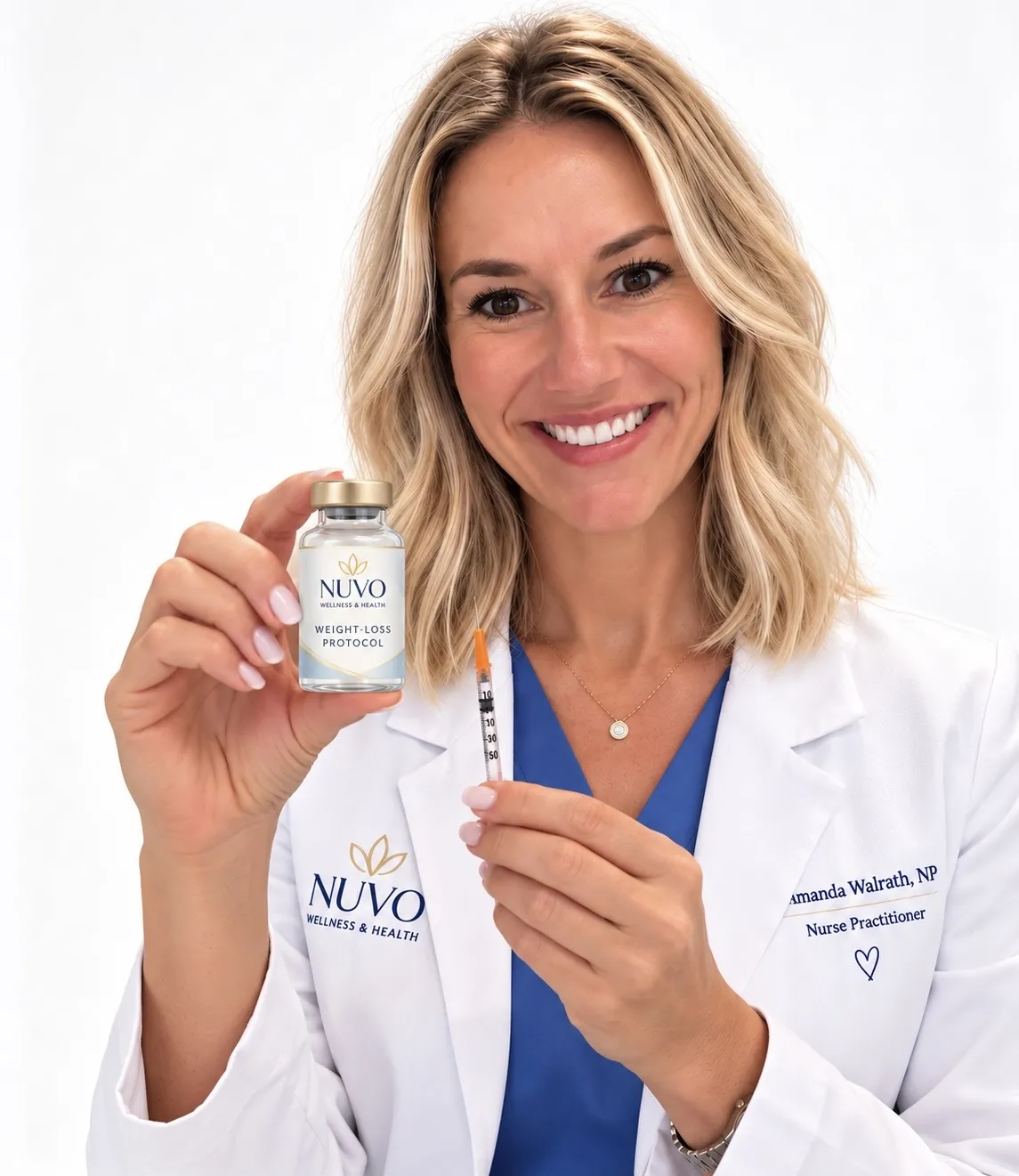
This GLP-1 patient guide covers the practical side of treatment with compounded semaglutide or tirzepatide at Nuvo Wellness and Health: receiving and storing your medication, giving your weekly injection, reading your dose in syringe units, handling common side effects, and knowing when to reach out. Keep it handy, especially during your first month.
I'm Amanda Walrath, APRN, FNP-BC, the nurse practitioner who founded Nuvo. I've taken this same type of medication myself after struggling with my weight after having kids, so I know how many questions come up in the beginning. This guide is general education. Your prescription label and the instructions I give you always come first.
Medical emergency? Call 911. For severe abdominal pain that won't go away, repeated vomiting where you can't keep fluids down, signs of a serious allergic reaction (swelling of the face, lips or throat, trouble breathing), or fainting, seek urgent care right away.
When your medication arrives
After your prescription is sent, allow about 5–7 days for the pharmacy to prepare and ship it. Your medication ships overnight in a cold pack, with your supplies included.
–Open the package as soon as it arrives and put the vial in the refrigerator right away.
–Check that your name, the medication and the concentration on the label match what we discussed.
–Check the beyond-use date on the label and do not use the medication after that date.
–Make sure you received syringes and alcohol pads.
–If anything is missing, damaged, warm or doesn't match, don't use it. Call or text (772) 210-4649.
Storing your vial
–Keep the vial refrigerated, not frozen. Don't use medication that has been frozen.
–Store it in its box, away from light, and away from the back wall of the fridge where items can freeze.
–Follow any additional storage directions on your pharmacy label.
–When traveling, keep the vial cool in an insulated bag with a cold pack, and don't leave it in a hot car. Florida heat matters here.
How to give your weekly injection
Semaglutide and tirzepatide are injected once a week, under the skin (subcutaneously). Pick a day of the week you can remember, like "Sunday morning," and set a phone reminder. During your visit I'll walk you through the technique and answer your questions.
1.Wash your hands. Gather your vial, a new syringe and an alcohol pad.
2.Check the label and confirm your prescribed dose in both milligrams and units.
3.Wipe the top of the vial with an alcohol pad and let it dry.
4.Draw up exactly your prescribed number of units. Tap out any large air bubbles and recheck the line.
5.Choose a site: the abdomen (at least 2 inches from the belly button), the front of the thigh, or the back of the upper arm.
6.Clean the skin, pinch gently, insert the needle, and push the plunger slowly all the way down.
7.Remove the needle and put the used syringe straight into a sharps container. Never reuse or share syringes.
8.Rotate your injection site each week.
If you don't have a sharps container, a heavy-duty plastic container with a tight lid can work temporarily. Check your county's rules for safe disposal.
Dosing charts in syringe units
These are Nuvo's typical starting progressions. They apply only to the exact concentrations shown, measured with a U-100 insulin syringe (each unit is 0.01 mL). Dose increases are never automatic. Increase only when I tell you to, and always follow your prescription label.
When
Semaglutide (2.5 mg/mL)
Syringe units
Weeks 1–4
0.25 mg
10 units
Weeks 5–8, if directed
0.50 mg
20 units
Weeks 9–12, if directed
0.75 mg
30 units
Week 13+, if directed
1.00 mg
40 units
When
Tirzepatide (15 mg/mL)
Syringe units
Weeks 1–4
3 mg
20 units
Weeks 5–8, if directed
5.25 mg
35 units
Week 9+, if directed
7.5 mg
50 units
Never use a units chart from another clinic, pharmacy or social media post. The same dose in milligrams equals a different number of units at a different concentration. If you're unsure which line to draw to, stop and call or text before injecting.
Common side effects and how to manage them
The most common side effects are digestive: nausea, decreased appetite, constipation, diarrhea, heartburn, burping or bloating. Fatigue and mild injection-site redness can also happen. They're often most noticeable when you start or after a dose increase.
–Eat smaller meals and stop when you feel full.
–Go easy on greasy, fried or very rich foods, especially around injection day.
–Sip water through the day. Dehydration can make nausea, fatigue and constipation worse.
–Add fiber gradually and keep moving to help with constipation.
–Limit alcohol, which can worsen stomach upset and dehydration.
–Tell me if side effects aren't improving. We can slow down or adjust your plan.
When to contact Nuvo
–Nausea, vomiting or diarrhea that keeps you from eating or drinking normally.
–Signs of dehydration, such as dizziness, very dark urine or urinating much less.
–Pain in the upper right abdomen, yellowing of the skin or eyes, or pain that spreads to your back.
–A lump or swelling in the neck, trouble swallowing or ongoing hoarseness.
–Symptoms of low blood sugar (shakiness, sweating, confusion), especially if you also take insulin or a sulfonylurea.
–You become pregnant or plan to become pregnant.
–You start any new medication or have a surgery or procedure scheduled.
Call or text (772) 210-4649 during office hours: Monday to Friday 9 to 5, Saturday 10 to 2. For anything severe or after hours, go to urgent care or call 911.
Important safety information
Semaglutide and tirzepatide aren't right for everyone. Before prescribing, I review your health history, and you should tell me about any of the following: a personal or family history of medullary thyroid cancer or Multiple Endocrine Neoplasia syndrome type 2 (MEN2); a history of pancreatitis; gallbladder disease; kidney problems; diabetic eye disease; pregnancy, breastfeeding or plans to become pregnant; and every medication and supplement you take.
Because these medications slow how quickly the stomach empties, they can affect how some oral medications are absorbed. If you use birth control pills and are on tirzepatide, ask me about adding a backup method, especially when starting and after dose increases. Let any surgeon or anesthesia team know you're on a GLP-1 medication before a procedure.
Eating, hydration and activity
Medication works best as one part of a bigger plan. Simple habits help you feel better and protect your muscle while you lose weight.
–Eat protein first at each meal, such as eggs, Greek yogurt, fish, chicken, beans or tofu.
–Fill the rest of your plate with vegetables, fruit and whole grains.
–Keep a water bottle with you, especially in the Florida heat.
–Include strength training two or more days a week if your health allows, plus regular walking.
–Prioritize sleep. Poor sleep can make appetite and energy harder to manage.
Follow-ups and refills
Follow-up visits are by telehealth, whenever you need one or when you're due for a refill. Reach out before your vial runs low so there's time for the pharmacy to prepare and ship your next one. Each vial is priced on its own, with no monthly membership. Compounded semaglutide is $400 per vial and compounded tirzepatide is $500 per vial, each including medication, supplies, shipping and follow-up.
How to get started with Nuvo
1.Book your complimentary virtual consultation online or call (772) 210-4649.
2.Complete your intake form with your health history, medications and goals.
3.Meet with me by video. We'll talk through whether treatment may be medically appropriate for you.
4.If prescribed, your medication and supplies ship directly to your Florida address, with ongoing follow-up included.
GLP-1 patient guide: common questions
What should I do if I miss a GLP-1 injection?
Don't double your next dose. The right step depends on how many days it has been and which medication you take, so call or text Nuvo at (772) 210-4649 for guidance.
Can I take my semaglutide or tirzepatide on a different day?
Often you can change your weekly injection day, but there are timing rules. Check with your provider before switching.
Does my GLP-1 vial need to stay refrigerated?
Yes. Keep your compounded vial refrigerated and follow the storage directions and beyond-use date on your pharmacy label. Don't freeze it.
How long does a vial last?
At Nuvo, a vial is designed to last about 12 weeks, but it depends on your individual dose. Your provider will tell you when to reorder.
Is nausea on semaglutide or tirzepatide normal?
Mild nausea is common, especially after starting or increasing a dose, and often eases over time. Contact your provider if it is severe, lasts or keeps you from drinking fluids.
This guide is for educational purposes and is not medical advice. Compounded medications are prepared by a licensed compounding pharmacy for an individual patient; they are not FDA-approved and are not reviewed by the FDA for safety, effectiveness or quality. Prescriptions are issued only after a medical evaluation determines treatment is appropriate. Individual results vary. Your pharmacy label and your provider's written instructions control.